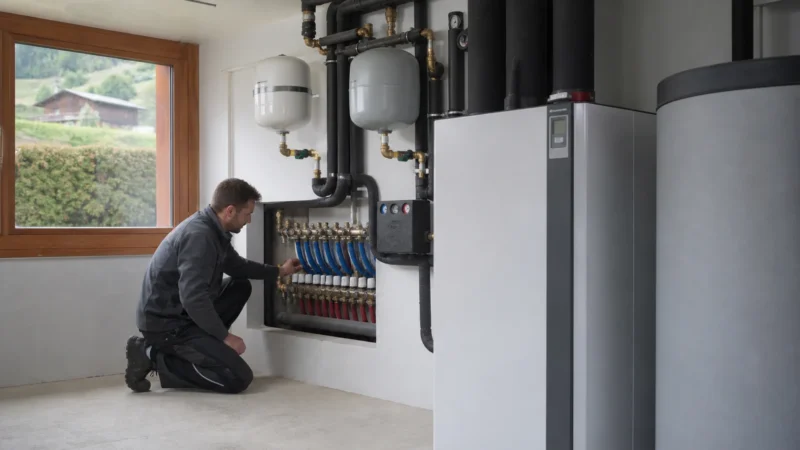
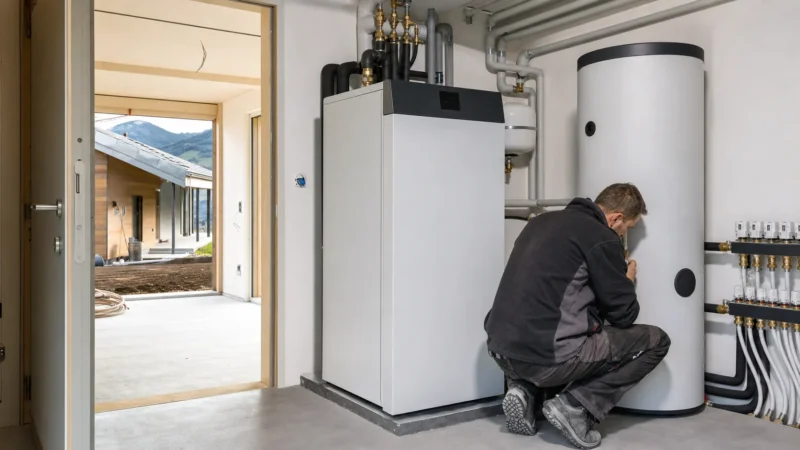
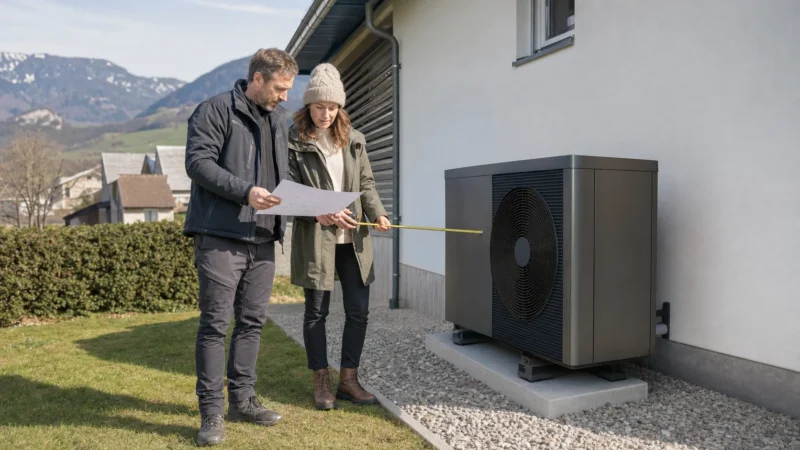
A water-to-water heat pump uses groundwater as its heat source. Because groundwater has a relatively constant, comparatively high temperature year-round, this solution can be very efficient. However, it is highly site-dependent and the most permit-intensive of all heat pump types: without suitable groundwater and the necessary permit or concession, it cannot be implemented.
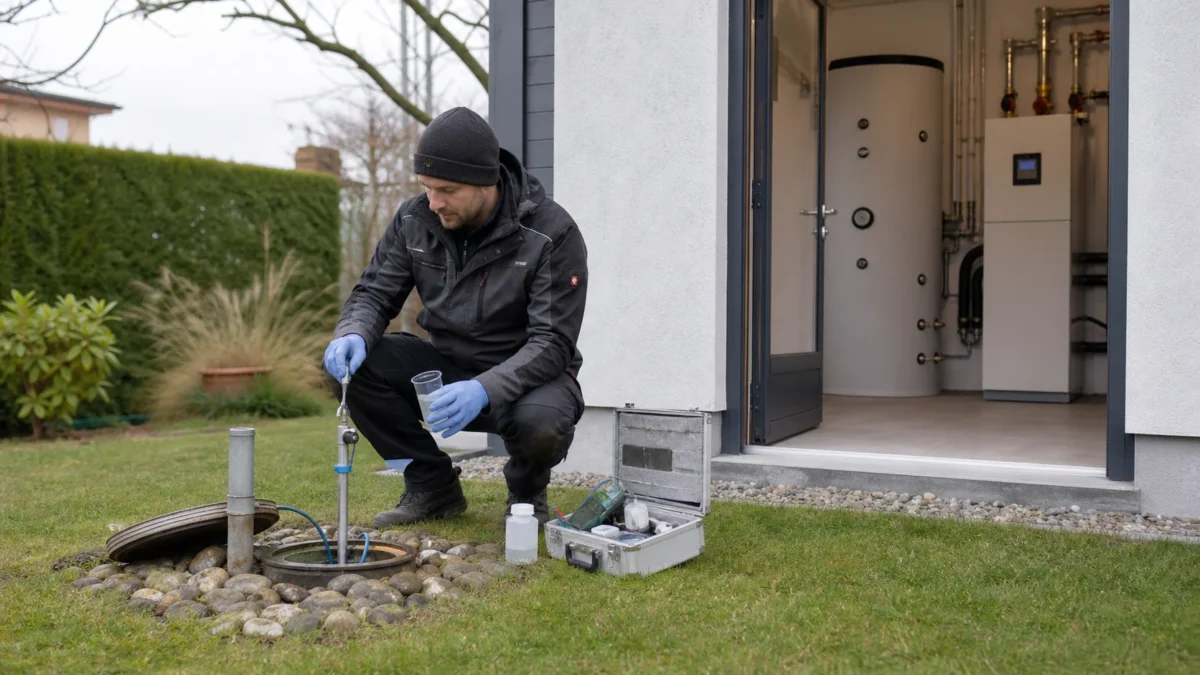
The most important points in brief
- uses groundwater as a constant, abundant heat source
- often very high efficiency possible
- not feasible everywhere – highly site-dependent
- Permit-intensive; depending on the canton, a concession may be required
- Water quality and water quantity are crucial
- well construction increases effort and costs
- As of 12.07.2026
- Sources at the end of the article
How it works
Groundwater is drawn from an abstraction well and fed to the heat pump. It extracts heat from the water for space heating and domestic hot water, then returns the cooled water to the groundwater through a second well (injection or return well). The high, stable source temperature can enable good seasonal performance factors.
Prerequisites
For a water-to-water heat pump to be an option, several conditions must be met:
- suitable groundwater at accessible depth
- sufficient and permanent water quantity
- suitable water quality (chemical composition, iron/manganese content)
- Permit or concession from the relevant authority
- space for supply and return wells
Whether these prerequisites are met is usually shown by a hydrogeological report. This information provides an overview and is not legally binding.
Compare quotes for free Are you wondering whether your location is suitable for a water-to-water heat pump? Through waermepumpen-guide.ch, you can submit your request free of charge and without obligation. Your request will be forwarded to up to three suitable specialist installers in your region who will check the suitability. Compare quotes for free
Permit
The use of groundwater is subject to a permit; depending on the canton, it is linked to a concession. The responsible authority is usually the cantonal environmental or water protection office. The basis is usually a hydrogeological report that assesses the quantity, quality and impacts of the extraction. In groundwater protection zones, use is often restricted or not permitted. The procedure is more complex than for other types of heat pumps and should be started early.
Costs and effort
As of July 2026. For a single-family home, SwissEnergy lists costs of approx. CHF 60’000–85’000 for a water-to-water heat pump, including installation and storage. A significant portion is attributable to the two wells and the expert report. These guidelines do not replace a quote:
| Point | Note |
|---|---|
| Abstraction and return wells | Major cost block |
| permit / expert report | Hydrogeological assessment required |
| Water quality | affects technology and maintenance |
| Maintenance | Check water flow and wells regularly |
An overview is provided by How much does a heat pump cost in Switzerland?.
Get a realistic assessment of the effort. Because wells, expert reports and permits vary greatly, it is worth comparing several specialist installers. Through waermepumpen-guide.ch you can reach up to three suitable specialist installers from your region – free of charge and without obligation. Compare quotes for free
Comparison of heat pump types
| Type | Short description |
|---|---|
| Air-to-water | easiest to implement, no drilling required |
| Brine-to-water (borehole) | efficient and stable, drilling and permit |
| Water-to-water (groundwater) | high efficiency potential, but most dependent on location |
Details on the alternatives: borehole heat pump, brine-to-water heat pump and air-to-water heat pump.
Typical errors
- Not assessing suitability early. Without suitable groundwater, this solution is impossible.
- Underestimating water quality. It affects technology, maintenance, and lifespan.
- Ignoring the work needed to obtain a permit. The procedure takes time and requires an expert report.
- Forgetting maintenance. Wells and the water circuit must be maintained.
Checklist before the quote
- check (or have checked) hydrogeological suitability and groundwater protection
- Check water quantity and quality
- Document the permit/concession process
- List well, equipment, expert report and dismantling separately
- take maintenance effort into account
- plan a realistic timeline including procedures
The groundwater test is only part of the project planning. Equally important are the correct sizing of the heat pump, the location-specific heat pump subsidy 2026 and, for a new build with a heat pump, early coordination with the plant room and heat distribution.
When is it worth comparing multiple quotes?
With water-to-water solutions, quotes differ particularly strongly – in terms of wells, expert reports, permits and technology. A comparison of several specialist installers makes this visible. Two to three complete quotes are usually sensible for this purpose. What you should pay attention to is shown in the Checklist for comparing quotes.
Conclusion
The water-to-water heat pump is a specialised solution with high efficiency potential – but only for suitable sites with sufficient groundwater and an issued permit. Because assessing suitability and the process are complex, an early assessment and a quote that transparently lists the well, expert reports, and permit are worthwhile. Multiple offers help to compare the effort realistically.
Compare heat pump quotes Through waermepumpen-guide.ch, you can submit your request free of charge and without obligation. Your request will be forwarded to up to three suitable specialist installers from your region, who will prepare individual quotes. Compare quotes for free
Frequently asked questions and answers
What is a water-to-water heat pump?
A heat pump that uses groundwater as a heat source – via an abstraction and a return well.
Do you need a permit?
Yes. Groundwater use is subject to permit or concession requirements and usually requires a hydrogeological report.
Is it efficient?
Often yes, if the quantity and quality of the groundwater are suitable. The stable source temperature can enable good seasonal performance factors.
Who is it suitable for?
For locations with suitable, sufficiently productive groundwater and an issued permit.
What does a water-to-water heat pump cost?
For a single-family home, SwissEnergy quotes roughly CHF 60’000–85’000 including installation and storage; the actual costs depend heavily on the well, groundwater use, permit, water quality and location (as of July 2026).
Sources and further information
- SwissEnergy / Swiss Federal Office of Energy (SFOE): Fundamentals and efficiency of heat pumps
- Cantonal environmental or water protection authorities: groundwater use and concession
- The Buildings Programme: cantonal subsidy logic for heating replacement (as of 2026)
- Energiefranken: Subsidy programmes by location
- Swiss Heat Pump Association (FWS): planning and operation