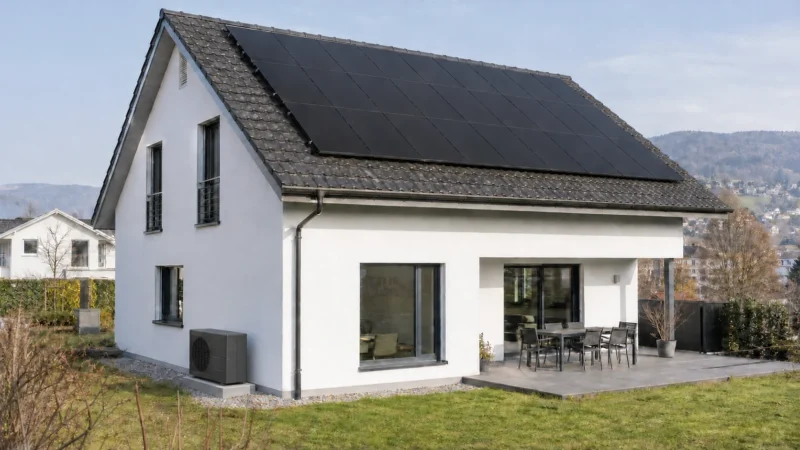
A heat pump in an older building is often possible – but not without careful examination, and not always the best solution. What matters less is the year of construction than how well the building envelope is insulated and at what flow temperature the house gets warm. The lower this temperature, the more efficiently a heat pump operates. Anyone who clarifies these points before requesting a quote avoids later surprises regarding comfort and operating costs.
The most important points in brief
- Many older buildings can be heated with a heat pump – but this cannot be stated as a general rule.
- The flow temperature is the most important technical point.
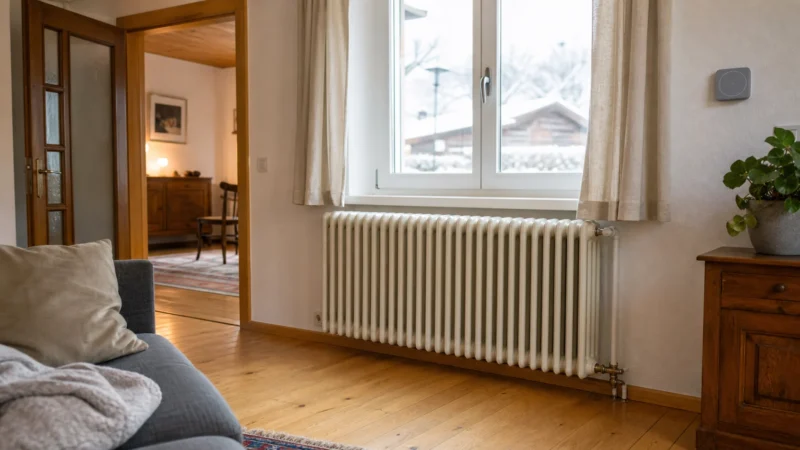
- Existing radiators are not a reason for exclusion, but they must be checked.
- Insulation, windows and domestic hot water demand strongly influence efficiency.
- Additional costs may arise from dismantling, replacing radiators, hydraulic balancing or sound insulation.
- A building assessment – for example through an initial consultation or GEAK – provides clarity before requesting a quote.
- As of 12.07.2026
- Sources at the end of the article
When does a heat pump work in an older building?
A heat pump works particularly well if the building has already been partially renovated (for example new windows or an insulated roof), large heating surfaces are available and the flow temperature remains moderate. However, it is often also possible in less extensively renovated buildings – then more detailed planning and possibly individual additional measures are required. The blanket statement 'a heat pump always works in an older building' is just as wrong as a blanket no. What matters is the specific property.
Flow temperature as a key factor
The flow temperature is the temperature at which the heating water flows into the heat emitters. The lower it is, the less electricity the heat pump requires. As a rough guide:
| Flow temperature | assessment |
|---|---|
| up to approx. 35 °C | very good prerequisite |
| 35–50 °C | often feasible |
| 50–55 °C | check in more detail |
| permanently higher | Check for refurbishment, radiator replacement or hydraulic balancing |
Important: The required flow temperature is best seen in operation – for example on the coldest days. A specialist installer can derive it from the heating load, heat emitters and building condition.
Compare quotes for free You would like to know whether a heat pump is suitable for your older building and which solution it would be? Through waermepumpen-guide.ch, you can submit your request free of charge and without obligation. Your request will be forwarded to up to three suitable specialist installers in your region, who will assess suitability and prepare individual quotes. Compare quotes for free
Radiators or underfloor heating?
Underfloor heating is ideal because it operates at low temperatures – but it is not mandatory. Existing radiators may be sufficient if they are dimensioned large enough and the house does not require too much heat. Often, replacing only individual critical radiators is enough, rather than all of them. You can read in detail how a heat pump works with radiators under Heat pump with radiators.
Insulation and building envelope
Insulation is not a prerequisite in every case, but it strongly influences heat demand and efficiency. With very high heat demand, improving the building envelope – such as the roof, windows or facade – may be sensible, as it lowers the required flow temperature. Whether this is worthwhile depends on the individual case: Sometimes the targeted replacement of some radiators is more economical than a major renovation, sometimes the other way around.
Building analysis: initial consultation and GEAK
Before you commit, a neutral analysis provides clarity. Two proven instruments in Switzerland:
- Initial consultation under the «erneuerbar heizen» programme: A trained professional inspects the building on site and explains how the heating system can be renewed, without favouring a particular technology. This SwissEnergy service is free for owners if the existing heating system is more than ten years old. It cannot be combined with cantonal subsidies for the same consultation (as of July 2026).
- GEAK (cantonal building energy certificate): It assesses the energy status of the building; the GEAK Plus additionally contains a consulting report with renovation variants. In some cantons, it is also a prerequisite or additional criterion for subsidy contributions.
Both help to realistically assess suitability before a quote is obtained.
Costs in an older building
As of July 2026. In addition to the actual heat pump, individual items may be added in an older building. These guidelines do not replace a quote:
| Additional item | Rough guideline |
|---|---|
| Removal of the old heating system (boiler) | approx. CHF 1’500–3’000 |
| Decommissioning and disposal of the oil tank | approx. CHF 1’500–3’500 |
| Replacement of individual radiators (per unit) | approx. CHF 800–1'800 |
| Hydraulic balancing | approx. CHF 1’500–3’000 |
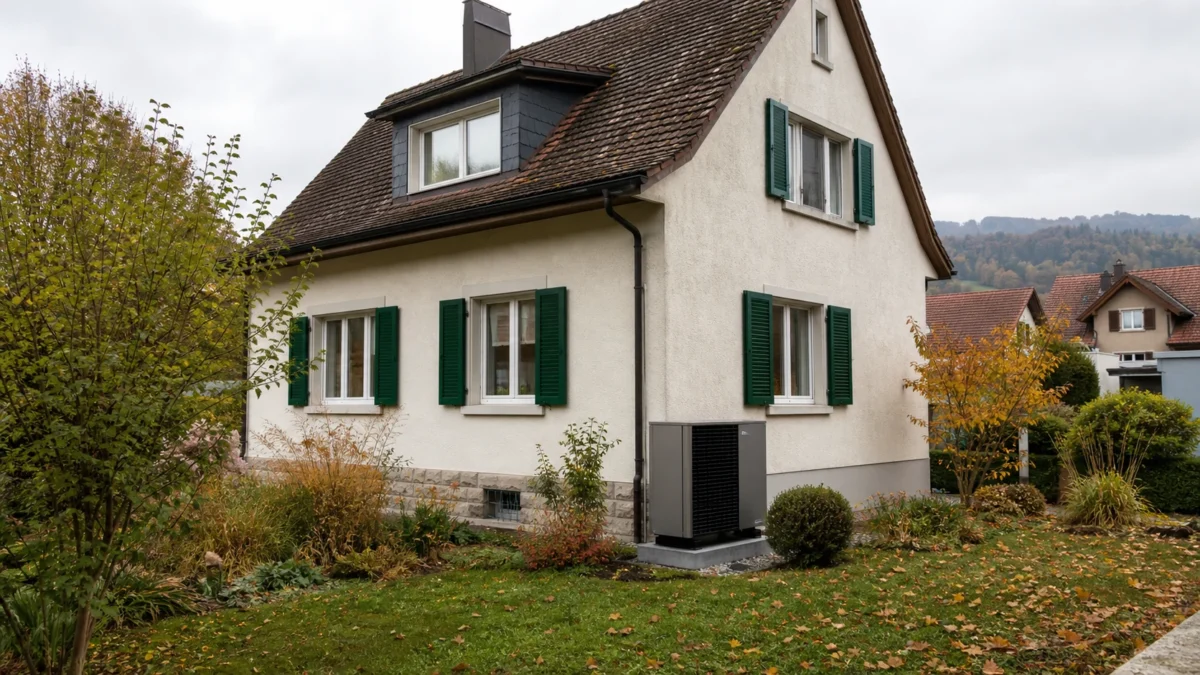
| Sound insulation (for air-to-water outdoor unit) | project-dependent |
The heat pump itself is roughly CHF 30’000–55’000 turnkey for a single-family home (air-to-water) or higher for borehole solutions. An overview is provided in What does a heat pump cost in Switzerland?. Subsidies can reduce the investment, but they are regulated at cantonal level and not guaranteed – more on this under Heat pump subsidy Switzerland 2026.
Have additional work calculated transparently Especially in older buildings, it is worth having several specialist installers assess and itemise the necessary additional work. Through waermepumpen-guide.ch you can reach up to three suitable specialist installers from your region – free of charge and without obligation. Compare quotes for free
Typical errors in older buildings
- Promising or rejecting suitability without an assessment. Both approaches are misleading; the specific flow temperature is what matters.
- Replacing all radiators as a precaution. Often, targeted replacement of individual undersized radiators is sufficient.
- Skipping hydraulic balancing. It ensures that heat reaches where it is needed and reduces consumption.
- Overlooking dismantling and tank disposal. They belong as separate items in the quote.
- Underestimating the location of the outdoor unit. Clarify noise and boundary distances early, not just after ordering.
Checklist before the quote
- Energy consumption (oil, gas, electricity) of recent years
- Required flow temperature or behaviour on cold days
- Size and condition of the radiators or underfloor heating
- Insulation, windows and condition of the building envelope
- Domestic hot water demand and number of people
- Possible location for the outdoor unit
- Subsidy options in canton and municipality
- Removal of the old heating system and tank disposal
For the specific renovation, building data and system choice should be considered together. An air-to-water heat pump is often an option; however, the correct sizing of the heat pump and a plan that avoids the most common heat pump errors from the outset remain crucial.
When is it worth comparing multiple quotes?
In an older building, details are decisive – and that is exactly where quotes differ most: in heating output, assumed flow temperature, necessary radiator replacement, hydraulic balancing, sound insulation, dismantling and subsidy assumptions. A comparison of several specialist installers makes these differences visible and helps to find the right solution for your property. Two to three complete quotes are usually sensible for this purpose. What you should pay attention to is shown in the Checklist for comparing quotes.
Conclusion
An older building does not rule out a heat pump – but it requires an honest assessment. Assessing flow temperature, radiators and the building envelope realistically, using an initial consultation or GEAK where appropriate, and obtaining a quote with clearly itemised additional work provides a sound basis for a decision. Several quotes help identify a suitable, economically sensible solution.
Compare heat pump quotes Via waermepumpen-guide.ch you can submit your request free of charge and without obligation. Your request is forwarded to up to three suitable specialist installers in your region, who will assess your property and create individual quotes. Compare quotes for free
Frequently asked questions and answers
Can a heat pump be installed in an older building?
Often yes, but not automatically. The building envelope, radiators, and above all the flow temperature must be checked.
Do you need underfloor heating?
No. Sufficiently large radiators can work. Underfloor heating is ideal, but not mandatory.
Do you need to insulate first?
Not always. With high heat demand, better insulation may be sensible because it lowers the required flow temperature. Sometimes replacing individual radiators is sufficient.
What does a heat pump cost in an older building?
The heat pump itself, turnkey, is approximately CHF 30'000–55'000 (air-to-water). Dismantling, tank disposal, radiator replacement, or hydraulic balancing may be added (as of July 2026).
Who checks whether my house is suitable?
A specialist installer as part of the quote – or beforehand through a neutral assessment via the free initial consultation under the «erneuerbar heizen» programme or GEAK.
Sources and further information
- SwissEnergy: initial consultation under the «erneuerbar heizen» programme and guidance on heating replacement
- GEAK: cantonal building energy certificate and GEAK Plus
- The Buildings Programme: cantonal subsidy logic for heating replacement (as of 2026)
- Energiefranken: Subsidy programmes by location
- Swiss Heat Pump Association (FWS): planning, flow temperature and operation