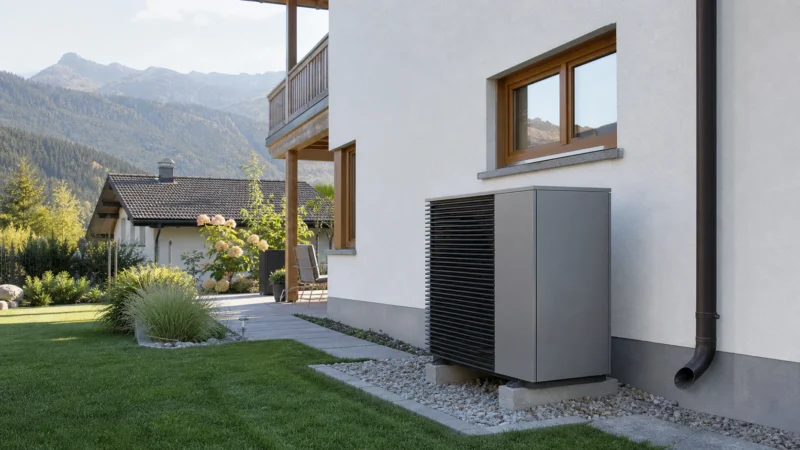
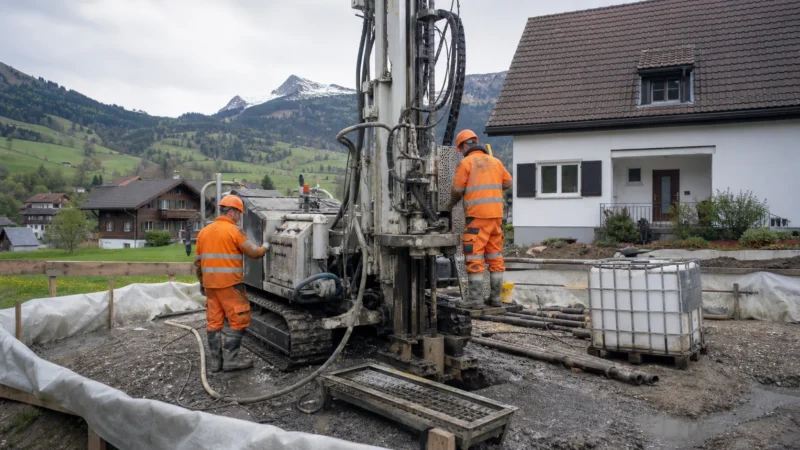
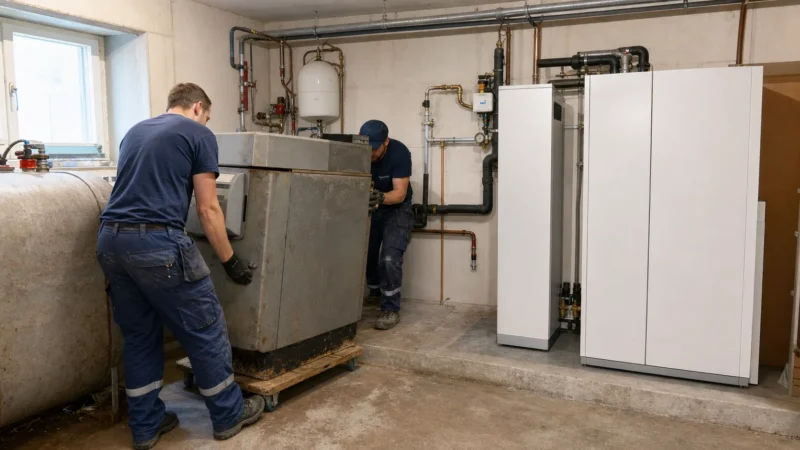
The air-to-water heat pump is the most common solution for single-family homes in Switzerland – it accounts by far for the largest share of heat pumps sold. It uses outside air as a heat source and transfers the extracted heat to the heating system and domestic hot water. Its major advantage: no borehole drilling is required. However, location, sound insulation and efficiency at low temperatures must be carefully planned.
The most important points in brief
- uses the outside air as a heat source, without drilling
- usually easier and cheaper to implement than borehole solutions
- often easy to retrofit, even in existing buildings
- sound insulation and the location of the outdoor unit are central
- efficiency drops at very low outdoor temperatures
- in older buildings, radiators and flow temperature are decisive
- As of 13.07.2026
- Sources at the end of the article
How it works
The outdoor unit extracts heat from the ambient air – even at minus temperatures, usable energy is still contained in the air. The heat pump raises this temperature level using electricity and thereby supplies the heating system and the domestic hot water storage tank. There are three variants for installation:
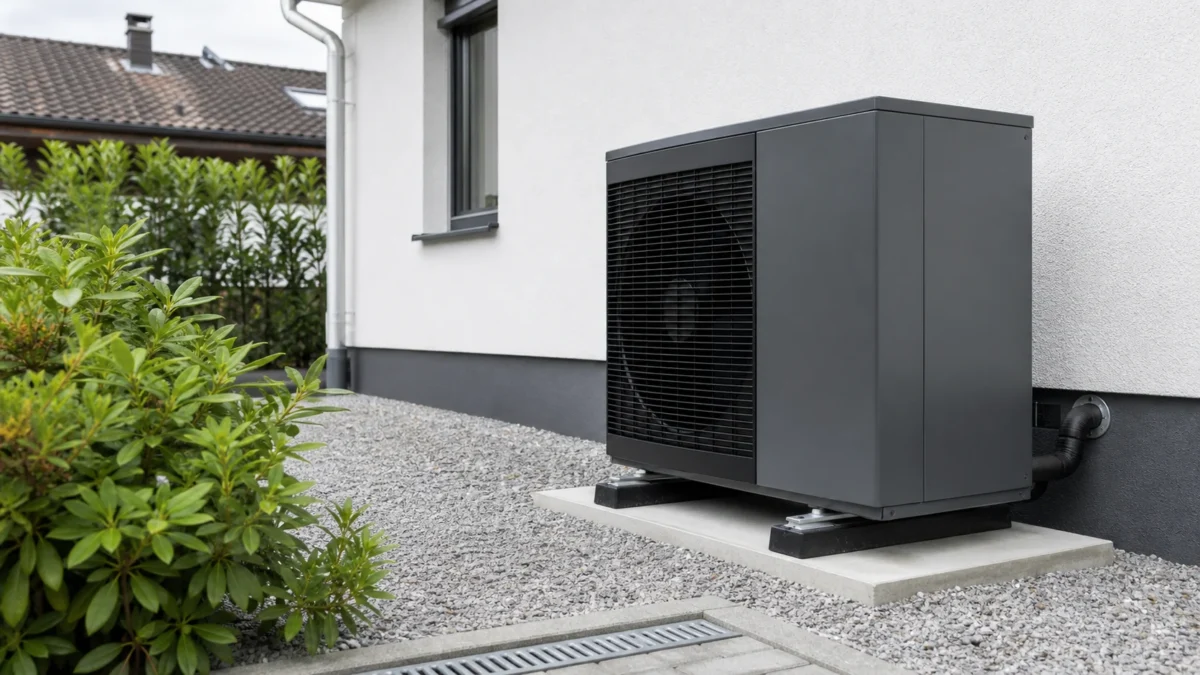
- Outdoor installation: The unit is located completely outdoors; only insulated water pipes lead into the house.
- Indoor installation: The unit is located in the plant room or basement; air is supplied and extracted via ducts.
- Split system: The outdoor and indoor units are separate and connected via a refrigerant circuit.
Which variant is suitable depends on space, floor plan, and noise situation. Modern units increasingly operate with natural refrigerants (such as propane) – for reliability and operation, the choice of refrigerant is not a reason to wait with the switch-over according to the current state of knowledge.
Advantages and disadvantages
| Category | Points |
|---|---|
| Advantages | no drilling required, usually simpler and cheaper installation, good retrofitting potential, short implementation time |
| Disadvantages | noise and location need planning, lower efficiency at very low temperatures, notification or permit requirements depending on location |
Who is it suitable for?
The air-to-water heat pump is often the most pragmatic choice – in new builds anyway, but also when renovating existing buildings. The prerequisite in an older building is that the radiators and flow temperature are suitable (see Heat pump in an older building and Heat pump with radiators). Where particularly high, year-round stable efficiency is required and the location allows it, a borehole heat pump may be a sensible alternative. No type of system is fundamentally 'the best' – it depends on the building, location and budget. The guide Heat pump in Switzerland offers a cross-system overview on this.
Costs
As of July 2026. For a single-family home, a turnkey air-to-water heat pump is roughly CHF 30'000–55'000. The range arises from heating output, storage size, dismantling of the old heating system, electrical work, sound insulation and subsidy assumptions. The pure equipment price therefore says little – what matters is a complete quote. An overall overview is provided by What does a heat pump cost in Switzerland?, and for ongoing costs see Electricity consumption of a heat pump.
Compare quotes for free You want to know what an air-to-water heat pump costs for your building? Through waermepumpen-guide.ch, you can submit your request free of charge and without obligation. Your request will be forwarded to up to three suitable specialist installers from your region, who will prepare individual quotes. Compare quotes for free
Efficiency in winter
On cold days, the heat pump has to bridge a larger temperature difference, which reduces efficiency. Modern, inverter-controlled units adjust their output steplessly; for rare peaks, an electric auxiliary heating element can kick in. How efficiently the system operates over the year is shown by the seasonal performance factor (SPF) – values of around 3 to 4 are common in existing buildings. The lower the flow temperature, the better it will be.
Sound insulation and location
Sound insulation is the most frequently underestimated aspect of air-to-water heat pumps. The federal noise protection ordinance is decisive; additionally, cantonal and municipal regulations apply, often with boundary distances of around 3–5 m to the neighbouring property line. In many municipalities, the system is exempt from building permit requirements but subject to notification, provided that the requirements are met.
In practice, this means: deciding on the location of the outdoor unit early – preferably not directly opposite the neighbours' bedroom windows, with sufficient distance and, where necessary, with noise-reducing measures. A night setback can also help. What specifically applies depends on the canton and municipality and is clarified during planning. This is an overview and not legally binding information.
Consider the location early On preparing quotes, specialist partners assess possible locations and sound insulation. Through waermepumpen-guide.ch, you can reach up to three suitable specialist installers from your region – free of charge and without obligation. Compare quotes for free
Permit and subsidy
Whether a notification or permit is required depends on the canton and municipality. For indoor installation with air ducts, often only a notification obligation applies. Subsidies for replacing a fossil fuel heating system are possible but regulated at cantonal level and not guaranteed; the application must generally be submitted before construction begins. More on this: Heat pump subsidy Switzerland 2026.
Typical errors
- Choosing the location too late. Noise and boundary distances should be clarified before ordering.
- Using the old boiler output. An oversized heat pump cycles more frequently and operates inefficiently.
- Ignoring flow temperature in older buildings. It determines comfort and operating costs.
- Comparing only the equipment price. Dismantling, storage, noise protection and electrical work should be included in the quote.
- Not involving the neighbours. Discussing the location early on prevents later conflicts.
Quote checklist
- Manufacturer, model and heating output (dimensioned with justification)
- Installation variant (outdoor, indoor or split) and location
- Domestic hot water and buffer tank
- Sound insulation measures and boundary distances
- Electrical work and removal of the old heating system
- Subsidy assumptions, service and warranty
- Implementation timeline
With this design, efficiency and acceptance depend particularly strongly on the planning. The noise protection for heat pumps determines the suitable installation location, while the sizing of the heat pump prevents cycling and unnecessary electricity consumption. A compact overview also shows which planning errors with heat pumps occur frequently.
When is it worth comparing multiple quotes?
Quotes for air-to-water heat pumps often differ significantly – for example in heating output, installation variant, sound insulation, storage tank, dismantling, subsidy assumptions, and service. Comparing several specialist installers makes these differences visible and helps find the right solution for your property. Two to three complete quotes are usually sensible for this purpose. What you should pay attention to is shown in the checklist for comparing quotes.
Conclusion
The air-to-water heat pump is often the most pragmatic solution: no drilling required, usually more affordable and quick to implement. For it to run efficiently and without conflict, three things matter – a well-chosen location with sound insulation, an appropriate flow temperature and accurate sizing. Multiple quotes help compare all of this transparently.
Compare heat pump quotes Through waermepumpen-guide.ch you can submit your request free of charge and without obligation. Your request is forwarded to up to three suitable specialist installers in your region, who will check the location, sound insulation and output and create individual quotes. Compare quotes for free
Frequently asked questions and answers
How much does an air-to-water heat pump cost?
For a single-family home, turnkey costs are roughly CHF 30'000–55'000, depending on output and scope. Dismantling, storage and noise protection influence the price (as of July 2026).
Is an air-to-water heat pump noisy?
Modern units can be quiet. Location, distance and sound insulation are decisive – these should be planned early on.
Does it work in an older building?
Yes, if the flow temperature and radiators match. In existing buildings, an assessment is necessary.
Does it require drilling?
No. This is one of the main advantages over the borehole heat pump.
How efficient is it in winter?
Efficiency drops at low temperatures, but modern units compensate for this well. Over the year, seasonal performance factors of around 3 to 4 are common in existing buildings.
Sources and further information
- SwissEnergy / Swiss Federal Office of Energy (SFOE): Fundamentals and efficiency of heat pumps
- Swiss Heat Pump Association (FWS): market figures, quality and sound insulation
- Noise protection ordinance as well as cantonal and municipal requirements for sound insulation
- The Buildings Programme: cantonal subsidy logic for heating replacement (as of 2026)
- Energiefranken: Subsidy programmes by location