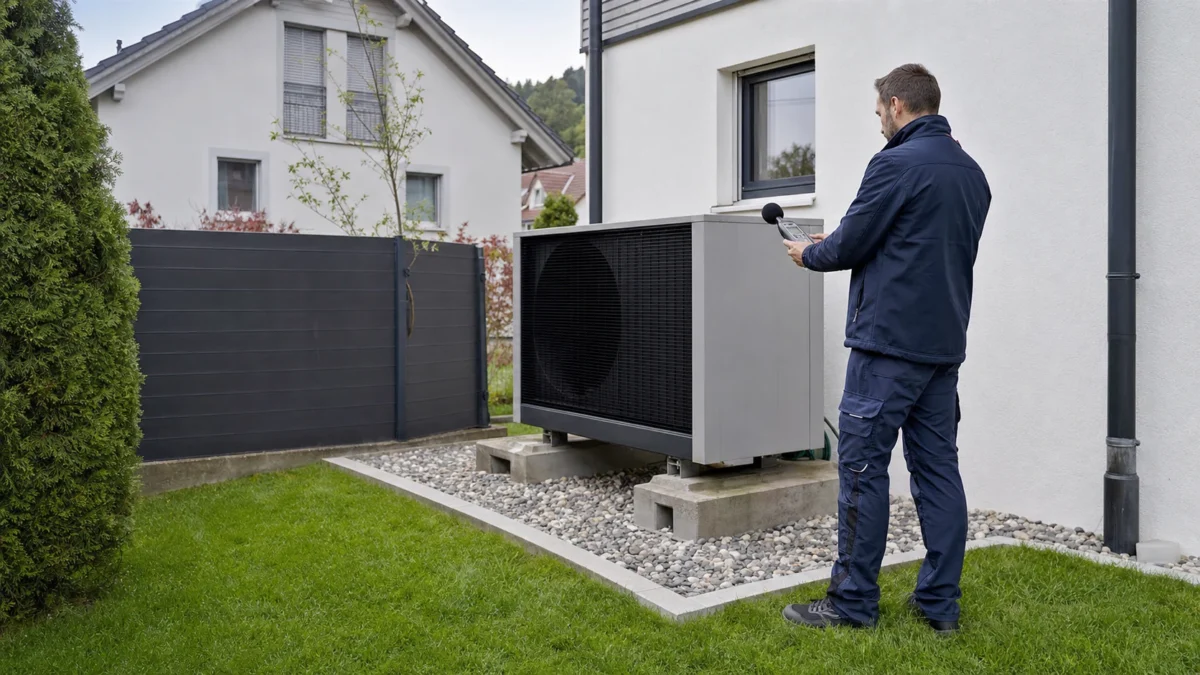
Noise protection is primarily an issue with air-to-water heat pumps, as the outdoor unit generates operational noise. Modern units can be quiet, but they vary significantly depending on the model, installation and operation. An unfavourable location can lead to conflicts with neighbours or problems in the permit process.
The good news: sound insulation can be planned. Those who consider the unit, location, proof and possible measures early on avoid costly remedial work.
The most important points in brief
- Air-to-water heat pumps cause outdoor noise, while borehole and water-to-water systems usually produce significantly less outdoor noise.
- The Noise Protection Ordinance as well as cantonal and municipal regulations are decisive.
- Depending on the project, proof of noise protection may be required.
- The FWS provides a web application with unit data for this purpose; the unit data are based on manufacturer specifications.
- Site selection and a quiet unit are the most important sound insulation measures.
- Sound insulation should be clearly stated in the quote.
- As of 12.07.2026
- Sources at the end of the article
Why does noise occur?
With air-to-water heat pumps, noise is generated primarily by the fan, air ducting, and compressor. How strongly these noises are perceived depends not only on the unit, but also on:
- Distance to the receiving location,
- Orientation of the unit,
- Reflections on walls or in corners,
- Operating hours during the day or at night,
- Night or whisper mode,
- Substrate and decoupling,
- Neighbourhood situation and windows.
Therefore, a quiet unit in an unfavourable location can be more problematic than a slightly louder unit with good placement.
The legal framework
The basis is the Environmental Protection Act and the Noise Protection Ordinance. In addition, cantonal and municipal implementation requirements apply. For air-to-water heat pumps, a building permit or a simplified notification procedure may be required depending on the canton, municipality, and installation location.
SwissEnergy points out that a building permit is required for air-to-water heat pumps in many cantons, particularly for outdoor installation and noise protection. In some cantons, there are simplified procedures for smaller systems. The local building authority is responsible.
This page is an overview and not legally binding information. What specifically applies should be clarified by the specialist installer with the municipality or the relevant authority.
Proof of noise compliance
For many projects, proof of noise protection is required or recommended. The Swiss Heat Pump Association (FWS) provides this together with the Cercle Bruit in the form of a sound calculator or web application. This is based on a directory of sound data for the devices. The device data comes from manufacturers or suppliers and lies within their responsibility.
The proof helps to assess the planned location, the specific device and the impact on noise-sensitive rooms. Whether a simplified procedure is sufficient or a full proof is required depends on the project and the canton.
Compare quotes for free You want to ensure that your heat pump complies with sound insulation requirements? Through waermepumpen-guide.ch, you can submit your request free of charge and without obligation. Your request will be forwarded to up to three suitable specialist installers from your region, who will assess the location and sound insulation. Compare quotes for free
Sound insulation measures
| Measure | Benefits |
|---|---|
| Suitable location | most important measure, avoids many problems from the outset |
| choose a quiet unit | reduces the output value |
| favourable orientation | avoids direct sound emission towards sensitive rooms |
| Avoid reflections | Walls, corners and niches can amplify noise |
| Decoupling | Reduces structure-borne noise in the building |
| Sound insulation hood or wall | can help depending on the situation |
| Night or whisper mode | can reduce noise during sensitive times |
A night setback or a whisper mode must not jeopardise the heat supply. If the output is reduced as a result, this must be taken into account in the sizing.
Which heat pump is quieter?
Borehole and water-to-water heat pumps do not have a typical outdoor unit with a fan. Therefore, outdoor noise is usually less relevant for them. Instead, indoor noise within the building must be considered, such as structure-borne noise from the compressor or pumps. Proper decoupling and installation are therefore also important for indoor units.
Those looking for a particularly quiet solution with a suitable location can consider a borehole heat pump. However, the most common solution remains the air-to-water heat pump, where sound insulation should be planned with particular care.
Think about the location early. The specialist partners assess the location, unit selection, and sound insulation as part of the quote. Through waermepumpen-guide.ch, you can reach up to three suitable specialist installers from your region – free of charge and without obligation. Compare quotes for free
Location tips
- Where possible, do not place the outdoor unit directly opposite bedroom windows.
- Avoid reflections from walls, courtyards and corners.
- Also take noise-sensitive rooms on your own property into account.
- In densely built-up areas, check for a particularly quiet unit early on.
- Have proof of noise compliance prepared before ordering.
- Have sound insulation measures listed separately in the quote.
Typical errors
- Choosing the unit's location afterwards rather than planning it early.
- Looking only at the unit price, not its noise level.
- Ignoring reflections from walls and corners.
- Not considering neighbours' windows or your own bedrooms.
- Clarifying proof of noise compliance or the notification procedure too late.
- Planning to use night mode without checking the output.
Checklist for sound insulation
- Clarify heat pump type and installation method
- Check the noise data of the specific device
- determine location and orientation
- Take reflections and the neighbourhood situation into account
- Check cantonal and municipal requirements
- Check proof of noise compliance or the notification procedure
- Have sound insulation measures specified in the quote
- Consider service access and operation
Noise is part of the overall planning and must not be considered in isolation. The sizing of the heat pump affects running times and cycling, while a water-to-water heat pump does not need an outdoor unit with airflow. The guide to the most common planning errors summarises further interactions.
When is it worth comparing multiple quotes?
Especially with sound insulation, differences become apparent: equipment choice, site concept, proof and measures are not planned the same way everywhere. Two to three complete quotes help to make these differences visible. What you should generally pay attention to is shown in the checklist for comparing quotes.
Conclusion
Noise protection can be planned for heat pumps. A suitable unit, a good location, properly prepared proof of compliance and early clarification of cantonal and municipal requirements are key. Having sound insulation clearly itemised in the quote helps avoid conflicts and later remedial work.
Compare heat pump quotes Via waermepumpen-guide.ch you can submit your request free of charge and without obligation. Your request is forwarded to up to three suitable specialist installers from your region, who will assess the location and sound insulation. Compare quotes for free
Frequently asked questions and answers
Are heat pumps loud?
Modern units can be quiet, but they differ depending on the model and installation. The choice of unit, location, and operation are decisive.
Is proof of noise compliance required?
Depending on the canton, municipality, and project, proof may be required. The competent authority or the specialist installer will clarify the procedure.
Which heat pump is quieter?
Borehole and water-to-water systems do not have a typical outdoor unit. For them, indoor noise from the technology is more relevant.
Who prepares the proof of compliance?
In practice, this is usually handled by the specialist installer or a professional. The basis can be the FWS noise calculator with equipment data.
Can noise be reduced afterwards?
Partially, for example with a sound insulation hood, decoupling or operational adjustment. However, good site and equipment planning from the outset is more effective.
Sources and further information
- Noise Protection Ordinance (LSV) and Environmental Protection Act (USG): legal foundations
- Swiss Heat Pump Association (FWS): noise calculator, proof of noise compliance and noise data directory
- Cercle Bruit: Implementation aids for the noise law assessment of air-to-water heat pumps
- SwissEnergy / Swiss Federal Office of Energy (SFOE): Approval and planning guidelines for heat pumps
- Cantonal and municipal enforcement offices: local requirements