Domestic hot water is a central and often underestimated part of heat pump planning. A system should not only heat the house but usually also reliably supply the shower, bath and kitchen. Because domestic hot water generally requires higher temperatures than space heating, it noticeably affects comfort, efficiency and electricity consumption. An appropriate storage concept therefore needs to be included in the planning from the start.
The most important points in brief
- Domestic hot water should be planned for the heat pump from the outset.
- The storage size depends on the number of people, consumption and comfort requirements.
- A domestic hot water heat pump is a specialist solution for hot water only.
- Domestic hot water can influence electricity consumption, as higher temperatures are required.
- Photovoltaics can support domestic hot water preparation during the day.
- Drinking water hygiene must be taken into account in planning and control.
- A good quote clearly shows storage, control, backup heating and service.
- As of 12.07.2026
- Sources at the end of the article
How does the heat pump produce domestic hot water?
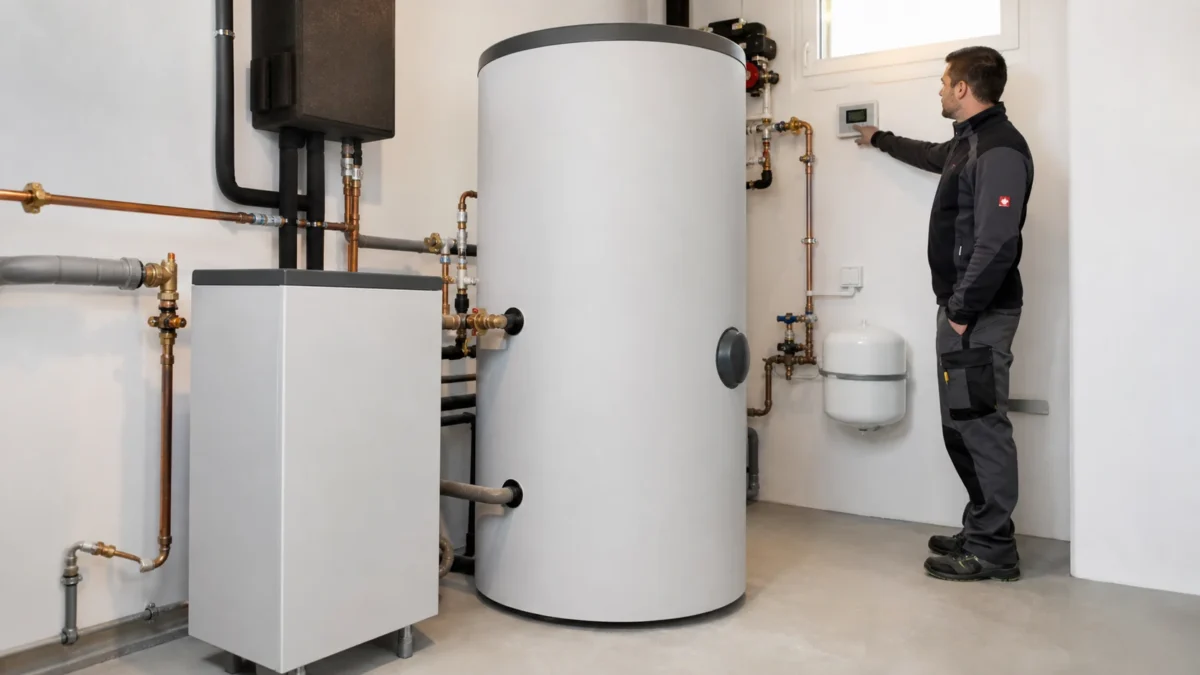
The heat pump heats domestic hot water in a hot water storage tank. SwissEnergy describes heat pumps as systems that generate sustainable heat for heating and for warming domestic hot water. The heat can be temporarily stored in hot water and buffer tanks.
For efficiency, it is important: domestic hot water generally requires higher temperatures than underfloor heating or large-area radiators. During these phases, the heat pump operates with a larger temperature difference. Therefore, storage size, temperature, control and domestic hot water demand should be planned together.
Solutions at a glance
| Solution | Use | What to look out for? |
|---|---|---|
| Space-heating heat pump with domestic hot water tank | Standard for complete heating replacement | Storage size, hygiene, efficiency |
| Domestic hot water heat pump | Domestic hot water only, no full heating | suitable for replacing a separate water heater |
| Electric water heater | Simple solution, but high electricity consumption possible | Check efficiency and operating costs |
| PV-controlled domestic hot water preparation | interesting with your own photovoltaic system | Plan control and daily operation |
The most common option when replacing a heating system is a space-heating heat pump connected to a domestic hot water tank. A domestic hot water heat pump is mainly an option when only hot water production is being renewed.
Compare quotes for free Are you looking to plan your heating and domestic hot water system together in a sensible way? Through waermepumpen-guide.ch, you can submit your request free of charge and without obligation. Your request is forwarded to up to three suitable specialist installers from your region, who will prepare individual quotes. Compare quotes for free
The right storage size
The storage size depends not only on the living area. More important are:
- Number of people in the household,
- Showering habits,
- Bathtub or multiple bathrooms,
- simultaneous domestic hot water draw-off,
- desired comfort,
- Domestic hot water temperature,
- Backup heating strategy,
- possible PV control.
A storage tank that is too small leads to comfort issues. A storage tank that is too large causes unnecessary heat losses and can increase costs. The correct storage size is therefore part of the sizing.
Domestic hot water and efficiency
Domestic hot water has a greater impact on the efficiency of the heat pump than many expect. Space heating often operates with lower flow temperatures, especially with underfloor heating or large heating surfaces. Domestic hot water, on the other hand, requires higher temperatures. Therefore, the system should not be designed solely for space heating.
Important questions:
- How many people use domestic hot water?
- Is there frequent bathing or predominantly showering?
- Are there peak times in the morning or evening?
- Should domestic hot water be produced preferentially during the day using PV electricity?
- How is hygienic operation ensured?
How domestic hot water affects consumption is shown in Electricity consumption of a heat pump.
Drinking water hygiene
Domestic hot water storage tanks must be operated in a hygienically safe manner. The specialist installer should specify in the quote how drinking water hygiene is ensured and which control system is provided for this purpose. Specific temperatures and operating modes depend on the system, storage tank, usage and applicable regulations.
It is important that efficiency and hygiene are not played off against each other. A very low domestic hot water temperature may save electricity, but must not come at the expense of drinking water hygiene.
Plan domestic hot water properly The specialist partners take storage size, drinking water hygiene and control into account as part of the quote. Through waermepumpen-guide.ch you can reach up to three suitable specialist installers from your region – free of charge and without obligation. Compare quotes for free
Domestic hot water with photovoltaics
Domestic hot water preparation is well suited for own solar power, because it can be shifted in time. If the domestic hot water is heated preferentially when the PV system supplies electricity, self-consumption increases. The domestic hot water tank then acts as a heat store. Whether additional storage technology is worthwhile depends on consumption, PV yield, control and electricity tariffs.
More on this: Heat pump with photovoltaics.
Cost factors
The domestic hot water solution influences the total costs of the heat pump. Key factors are:
| Cost factor | Significance |
|---|---|
| Storage size | a larger storage tank costs more and requires space |
| Hydraulics | Integration into heating and domestic hot water system |
| Control | Control based on times, PV yield or comfort needs |
| Drinking water hygiene | must be taken into account in the planning |
| Installation site | Space, connections and service access |
| Backup heating / additional functions | depending on the system and design |
Flat-rate price indications for individual storage solutions are of little use. A good quote lists the domestic hot water tank, control system and integration separately.
Typical errors
- Underestimating domestic hot water demand.
- Choosing a storage tank that is too small or too large.
- Not considering drinking water hygiene in the controls.
- Planning domestic hot water and heating separately.
- Forgetting PV control.
- Looking only at purchase costs, not operation and comfort.
Checklist for domestic hot water planning
- Record the number of people and consumption behaviour
- Take the bath and simultaneous demand into account
- Choose the right storage size
- Clarify domestic hot water temperature and hygiene requirements
- Have the control and backup heating explained
- Check PV-controlled domestic hot water preparation
- Ensure service access to the storage tank
- Have the storage clearly itemised in the quote
In a new build with a heat pump, the storage size can be coordinated early on with household size and heat distribution. A broader system overview is provided in the guide Heat Pump in Switzerland; the overview of heat pump planning shows which errors regarding storage, output and control should be avoided.
When is it worth comparing multiple quotes?
Quotes for domestic hot water often differ significantly – in terms of storage size, solution, control, hygiene, and integration. Two to three complete quotes help make these differences visible. What you should pay attention to is shown in the Checklist for comparing quotes.
Conclusion
Domestic hot water is not a detail, but a factor for comfort, efficiency and electricity consumption. Whoever considers storage size, drinking water hygiene, domestic hot water temperature, control and photovoltaics from the outset obtains a better overall solution. The key is a quote that clearly explains the domestic hot water concept.
Compare heat pump quotes Through waermepumpen-guide.ch, you can submit your request free of charge and without obligation. Your request will be forwarded to up to three suitable specialist installers from your region, who will prepare individual quotes. Compare quotes for free
Frequently asked questions and answers
Can a heat pump produce domestic hot water?
Yes, usually via a domestic hot water tank, which the heat pump heats up.
What is a domestic hot water heat pump?
A heat pump only for domestic hot water. It does not replace a complete heating system.
How large must the domestic hot water tank be?
This depends on household size, consumption, simultaneous demand and comfort requirements. A tank that is too small causes comfort problems; one that is too large causes unnecessary losses.
Does photovoltaics help with domestic hot water preparation?
Yes. Heating domestic hot water mainly during the day with your own solar electricity can increase self-consumption.
Do I need to consider hygiene for domestic hot water?
Yes. Drinking water hygiene must be considered in planning and control. The specialist installer should explain the concept in the quote.
Sources and further information
- SwissEnergy / Swiss Federal Office of Energy (SFOE): Domestic hot water, storage and efficiency of heat pumps
- Swiss Heat Pump Association (FWS): storage, domestic hot water and operation
- Federal Office of Public Health (FOPH): Drinking water hygiene and Legionella
- Energiefranken: Subsidy programmes by location