The cost of a heat pump cannot be answered with a single price – it depends heavily on the building and the scope of work. As a rough guide: a turnkey system for a single-family home costs between CHF 30’000 and 85’000 in 2026, depending on the type. Key factors are the heat pump type, heating output, domestic hot water, dismantling of the old heating system, electrical work, sound insulation, storage tanks, any drilling required, permits and subsidies. The Overview of heat pumps in Switzerland categorises the various systems and areas of application. A simple price list is therefore too limited; ultimately, only an individual quote is reliable.
The most important points in brief
- Turnkey costs for a single-family home are realistically CHF 30’000–85’000 – depending on the heat pump type and building (as of July 2026).
- Air-to-water heat pumps are usually cheaper than borehole or groundwater solutions.
- Dismantling, tank disposal, electrical work, and sound insulation are often underestimated.
- Subsidies can reduce the investment but are regulated at cantonal level and not guaranteed.
- Running costs depend mainly on efficiency (seasonal performance factor), heat demand and electricity tariff.
- A complete quote transparently lists all cost blocks – not just the unit price.
- As of 13.07.2026
- Sources at the end of the article
Why there is no fixed price
Figures ranging from «from CHF 15'000» to over CHF 85'000 circulate online. They often refer to different things: sometimes just the unit, sometimes the turnkey system including installation, and sometimes the total bill with dismantling, drilling and permits. A meaningful comparison therefore depends on exactly what is included in the price. The following indicative figures refer to a turnkey system in a single-family home.
Costs by heat pump type
As of July 2026. Indicative figures that do not replace an individual quote:
| Heat pump type | Indicative cost for a single-family home (turnkey) | Typical cost drivers |
|---|---|---|
| air-to-water heat pump | approx. CHF 30'000–55'000 | Outdoor/indoor unit, storage, sound insulation, electrical work, dismantling |
| Brine-to-water heat pump (borehole heat exchanger) | approx. CHF 50'000–80'000 | Drilling, permit, geology |
| water-to-water heat pump | approx. CHF 55’000–85’000 | Wells, groundwater concession, expert report |
| Domestic hot water heat pump | significantly lower | Domestic hot water only, no full heating |
The air-to-water heat pump is generally the most affordable full heating solution, as no ground works are required. With a borehole heat exchanger, the drilling alone often costs CHF 15’000–25’000, but the efficiency is usually higher. Details on the individual types: air-to-water heat pump and borehole heat pump.
Compare free heat pump quotes Do you want to know what a heat pump specifically costs for your building? Through waermepumpen-guide.ch you can submit your request free of charge and without obligation. Your request is forwarded to up to three suitable specialist installers in your region. This allows you to receive individual quotes and compare prices and services. Compare quotes for free
Which cost items are included?
The equipment price is only part of the cost. A complete quote covers significantly more – especially when replacing an oil or gas heating system. The following items should be included and itemised separately:
| Cost item | What lies behind it |
|---|---|
| Heat pump and heating output | Device, sized to match the calculated heating load |
| Domestic hot water tank / buffer tank | For comfort and efficient operation |
| Installation and hydraulics | Connection to the existing heating system |
| Electrical work | own connection, sometimes adjustment of the house’s electrical system |
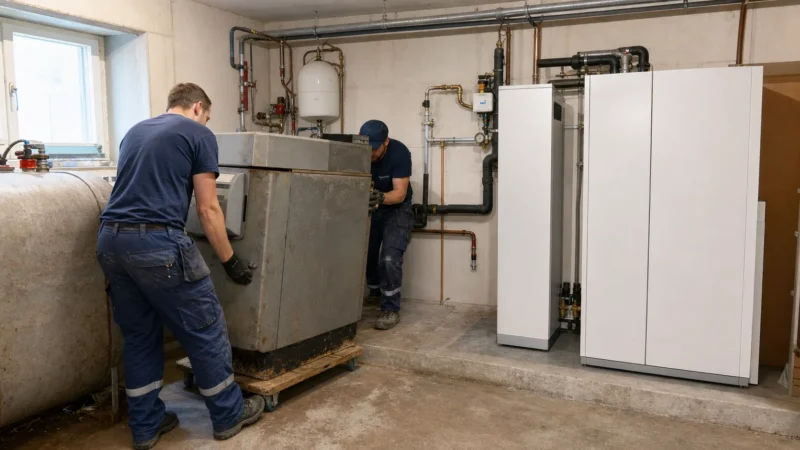
| Dismantling of the old heating system | Removal of heating boiler, disposal |
| Tank disposal / Decommissioning of oil tank | Cleaning and proper disposal |
| Sound insulation | especially for air-to-water outdoor units |
| Drilling and permit | Only with a borehole heat exchanger or groundwater |
| Hydraulic balancing | distributes heat correctly, reduces consumption |
| Adjustment of heat distribution | if necessary, replacement of individual radiators in older buildings |
In older buildings, adjustments to the heat distribution may be required depending on the situation – for example, replacing individual radiators that are too small. To find out what this means for suitability, read Heat pump in an older building.
Why two quotes can differ significantly
Two quotes can both include an air-to-water heat pump yet differ by several thousand francs. Reasons include differences in heating output and sizing, storage capacity, sound insulation, dismantling, assumed subsidies, planning detail and scope of service. The final price alone therefore says little unless it is clear what each quote actually includes.
Operating costs and electricity consumption
In addition to the investment, running costs count. They are mainly determined by the heat demand, the seasonal performance factor (SPF) – which describes how much heat is generated from one kilowatt-hour of electricity – and the electricity tariff.
A calculation example: If a building requires 16’000 kWh of heat per year and the heat pump achieves an SPF of 4, the electricity consumption is around 4’000 kWh. At the average Swiss household tariff of 27.7 Rappen per kilowatt-hour (ElCom, median 2026), this amounts to approximately CHF 1’110 in electricity costs, plus around CHF 300–450 for maintenance – totalling roughly CHF 1’400–1’550 per year. Important: The electricity tariff varies significantly depending on the grid operator (from around 10 to over 40 Rappen per kilowatt-hour in 2026), so the result may differ considerably by region. A cheap system with poor efficiency can become more expensive over the years than a better-planned solution. In-depth: Electricity consumption of a heat pump. Those who want to reduce their grid electricity consumption will find more information under Heat pump with photovoltaics. For joint investment planning, the Costs of a solar system for a single-family home can be taken into account as well.
Factors influencing the price at a glance
| Factor | Impact on costs |
|---|---|
| Heat pump type | high (air-to-water < borehole < groundwater) |
| Heating output / building size | high |
| Heat distribution (radiators/underfloor heating) | medium to high |
| Dismantling and tank disposal | medium |
| Sound insulation and location | medium |
| Drilling / permit (borehole heat exchanger, groundwater) | high |
| Subsidies | reduces the net costs |
Subsidy and net costs
As of July 2026. Subsidies can significantly reduce the investment. The central point of contact is the Buildings Programme from the federal government and cantons, which supports the replacement of fossil or electric heating systems. Because it is implemented at cantonal level, there is no uniform flat rate – the amounts vary by canton, reaching into the five-figure range in some cantons. Important: The application must generally be submitted before construction begins, and payment is made after installation.
In addition, heating replacement and dismantling can be deducted from taxes as property maintenance in most cantons (minus any subsidies received). However, due to the abolition of the imputed rental value decided in 2025, this deduction may disappear from the direct federal tax, probably from 2028 – it is worth checking the current situation. Subsidy amounts are never guaranteed; they should be checked on a location-specific basis before implementation. More on this: Heat pump subsidy Switzerland 2026.
Consider subsidies in the comparison The specialist partners can take possible subsidy options at your location into account when preparing the quote. Via waermepumpen-guide.ch you can reach up to three suitable specialist installers in your region – free of charge and without obligation. Compare quotes for free
Typical errors in costs
- Comparing only the unit price. Dismantling, storage, electrical work and sound insulation can significantly change the final price.
- Reusing the old boiler output. Oil boilers were often oversized; an oversized heat pump costs more and runs inefficiently.
- Budgeting for the subsidy as a certainty. Contributions are cantonal, budget-dependent and not guaranteed.
- Submitting the application too late. Those who apply after construction starts frequently lose the entitlement.
- Ignoring operating costs. A cheap but inefficient system can be more expensive over 15–20 years.
Checklist: realistically estimate costs
- Have the current energy consumption (oil, gas, electricity) of recent years ready
- Know the heat distribution system and approximate flow temperature
- Check the location for the outdoor unit or space for drilling
- Request dismantling and tank disposal as a separate item
- Clarify sound insulation and permits early on
- have the subsidy options in the canton and municipality checked
- For every quote, compare the scope of work, not just the final price
The large price differences become clearer when the development of the heat source is considered separately: For the brine-to-water heat pump, drilling or the ground collector shapes the investment, while for the water-to-water heat pump, it is wells and expert reports. Regardless of type, accurate sizing of the heat pump prevents unnecessary extra costs.
When is it worth comparing multiple quotes?
It is particularly in the costs that you can see how much quotes vary: heat pump type, heating output, domestic hot water, dismantling, sound insulation, subsidy assumptions and service are not calculated the same way everywhere. A comparison of several specialist installers makes these differences visible and helps to find the right solution for your property. Two to three complete, comparable quotes are usually sensible for this purpose. What you should pay attention to in detail is shown in the Checklist for comparing quotes.
Conclusion
Guideline values help for initial orientation, but the specific costs depend on the building, the system type and the scope of work. The key is a complete quote that transparently lists all items – from the unit to dismantling and sound insulation to the assumed subsidies. Those who obtain several offers can recognise differences and make an informed decision.
Compare heat pump quotes. Through waermepumpen-guide.ch you can submit your request free of charge and without obligation. Your request will be forwarded to up to three suitable specialist installers from your region, who will check your details and create individual quotes. Compare quotes for free
Frequently asked questions and answers
What does a heat pump cost for a single-family home?
Turnkey roughly CHF 30’000–85’000, depending on type and building. Air-to-water is usually cheaper than borehole or groundwater solutions. The actual costs depend heavily on the scope of work (as of July 2026).
Why are heat pump quotes so different?
Because dismantling, storage, sound insulation, electrical work, heating output and subsidy assumptions are accounted for differently. The final price alone says little.
What are the annual operating costs?
For a single-family home, roughly CHF 500–2’000 electricity per year plus around CHF 300–450 maintenance – depending on heat demand, seasonal performance factor and electricity tariff. The tariff varies significantly by region.
Are subsidies guaranteed?
No. They are regulated at cantonal level, depend on budgets and generally must be applied for before implementation.
Is the cheapest quote worth it?
Not automatically. A cheap but poorly planned system can be more expensive over the years. What matters is the ratio of investment, efficiency and operation.
Sources and further information
- SwissEnergy / Swiss Federal Office of Energy (SFOE): Fundamentals and efficiency of heat pumps
- The Buildings Programme: Conditions and cantonal implementation of heating replacement (as of 2026)
- Energiefranken: Subsidy programmes by location
- Federal Electricity Commission (ElCom): Electricity prices 2026 (median household tariff)
- Swiss Heat Pump Association (FWS): Quality, planning and operation