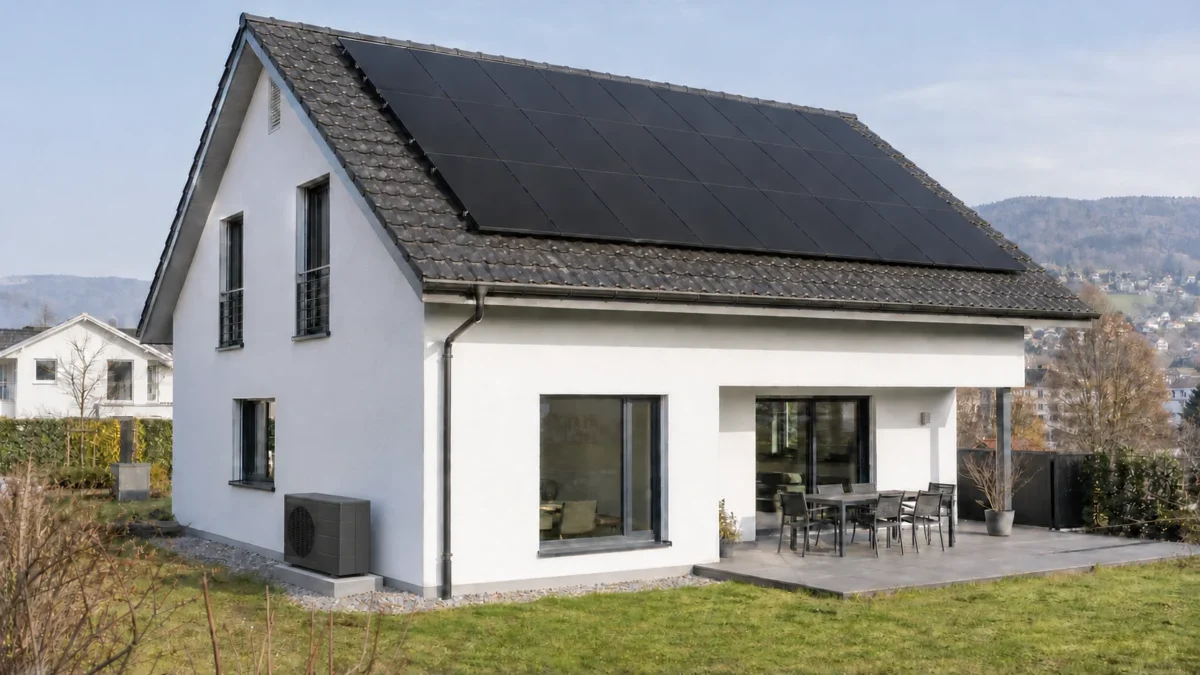
Combining a heat pump with photovoltaics can increase the self-consumption of self-generated solar power. The PV system supplies electricity, which the heat pump uses for heating and domestic hot water. Realistic planning over the entire year is essential: in summer and during the transitional periods, this works well together, but in winter, grid electricity usually remains important. A PV system therefore does not fully supply the heat pump throughout the year – however, it reduces grid consumption and makes operation more independent.
The most important points in brief
- PV electricity can be partially used for the operation of the heat pump.
- The self-consumption increases – particularly interesting in summer and during the transition period.
- In winter, PV production is low while heating demand is high; grid electricity remains important.
- The domestic hot water tank can store solar electricity indirectly as heat.
- A battery storage system is not automatically necessary, but a matter of calculation.
- Self-consumed solar electricity can be economically interesting because less grid electricity is purchased.
- As of 13.07.2026
- Sources at the end of the article
Why the combination makes sense
Self-consumed solar electricity replaces more expensive grid electricity. The heat pump creates an additional, partially controllable electricity consumer – for example for domestic hot water preparation during the day when the sun is shining. How much this pays off depends on the electricity tariff, PV yield, feed-in conditions, heat pump consumption and control. Feed-in remuneration and electricity tariffs should therefore be checked on a site-specific basis. The heat pump is a sensible consumer of solar electricity because, in particular, domestic hot water can be partially shifted in time.
Seasons at a glance
| Season | Classification |
|---|---|
| Summer | high PV production, low heating demand – ideal for domestic hot water |
| shoulder season | PV production and heating demand often match well |
| Winter | low PV production, high heating demand – grid electricity remains important |
The combination therefore smooths out grid consumption, but does not replace it. Realistic expectations are key: PV covers a portion of the heat pump’s electricity, particularly in the brighter half of the year.
Compare quotes for free Are you planning a heat pump and want to combine it sensibly with solar power? Through waermepumpen-guide.ch, you can submit your request free of charge and without obligation. Your request will be forwarded to up to three suitable specialist installers in your region who will create individual quotes. Compare quotes for free
Storage and control
There are two ways to make solar power usable beyond the moment of generation:
- Thermal storage: Domestic hot water tanks and buffer tanks can store solar electricity indirectly as heat. If domestic hot water is heated in advance during the day, it is ready in the evening – without a battery.
- Battery storage: It stores electricity for the evening. A battery storage system can be sensible, but it is not automatically necessary; whether it pays off depends on consumption, tariff and system size and should be calculated individually. How capacity, costs and economic viability are related is shown in the guide Photovoltaic system with storage.
A simple energy management system controls when the heat pump runs preferentially – for example, when the PV system is currently producing. This increases self-consumption without compromising comfort.
Domestic hot water with solar power
Domestic hot water preparation is particularly well suited for PV electricity because it can be shifted in time. Instead of early morning, the domestic hot water can be heated during midday when the yield is highest. This noticeably increases the share of self-consumed electricity, especially in summer.
Plan both systems in coordination The specialist partners can take into account how the heat pump, storage and control work together as part of the quote. Through waermepumpen-guide.ch you can reach up to three suitable specialist installers from your region – free of charge and without obligation. Compare quotes for free
How large should the photovoltaic system be?
There is no fixed rule: the appropriate PV output depends on roof area, orientation, heat demand, domestic hot water and other consumers such as an electric car. It makes sense to consider the heat pump and photovoltaics together – ideally already during planning, if both are foreseeable. The guide Calculating a solar system provides an initial assessment of possible output, yield, costs and storage size. The heat pump and any other future consumers should already be taken into account.
Typical misunderstandings
- “The PV system supplies the heat pump year-round.” Not in winter – production is low and heating demand is high at that time.
- “Without a battery, it is useless.” Domestic hot water storage and control already significantly increase self-consumption.
- “Bigger is always better.” The PV output should match consumption, not simply be maximised.
- “PV automatically makes the heat pump cheap.” The effect is real but limited and depends on usage and control.
Planning checklist
- check roof area, orientation and shading
- Estimate the heating demand and domestic hot water demand
- Take into account the flow temperature and efficiency of the heat pump
- Calculate the need for battery storage individually
- include other consumers (e.g. electric car)
- Plan energy management or control systems accordingly
- Align PV and heat pump quotes with each other
Solar electricity is used particularly well when the control system also includes domestic hot water preparation with a heat pump. In a new build with a heat pump, PV, storage and heat distribution can be coordinated from the start; in existing buildings, appropriate sizing of the heat pump remains the basis for efficient operation.
When is it worth comparing multiple quotes?
The interaction between the heat pump, storage and control differs noticeably in quotes – for example regarding domestic hot water solution, control, battery recommendation and sizing. Comparing several specialist installers makes these differences visible. Two to three complete quotes are generally sensible for this purpose. What you should look out for is shown in the Checklist for comparing quotes. How the heat pump’s consumption is composed can be read under Electricity consumption of a heat pump.
Conclusion
Photovoltaics and heat pumps work well together if expectations remain realistic and both systems are planned in coordination. PV reduces grid consumption and increases self-consumption – but it does not make the heat pump fully autonomous in winter. Those who consider domestic hot water, storage and control, and compare several quotes, get the best out of the combination.
Compare heat pump quotes Through waermepumpen-guide.ch, you can submit your request free of charge and without obligation. Your request will be forwarded to up to three suitable specialist installers from your region, who will prepare individual quotes. Compare quotes for free
Frequently asked questions and answers
Can photovoltaics fully power the heat pump?
Not year-round. In summer and during the transition period, yes, partly; in winter, grid electricity usually remains important.
Do you need battery storage?
Not necessarily. A domestic hot water tank and good control can already provide a lot of self-consumption. Whether a battery is worthwhile is a matter of calculation.
Is the combination worthwhile?
Often yes, if the roof area, consumption and control are suitable – provided the system is well controlled and the self-generated electricity can be used sensibly within the building.
Should you plan the heat pump and photovoltaic system at the same time?
If both are foreseeable, yes. This allows storage, control and sizing to be coordinated with one another.
When should the heat pump run for domestic hot water?
Ideally when the photovoltaic system is producing – usually around midday. An energy management system can control this automatically.
Sources and further information
- SwissEnergy / Swiss Federal Office of Energy (SFOE): Heat pump, photovoltaics and self-consumption
- Federal Electricity Commission (ElCom): Electricity prices and tariff data
- Energiefranken: Subsidy programmes by location