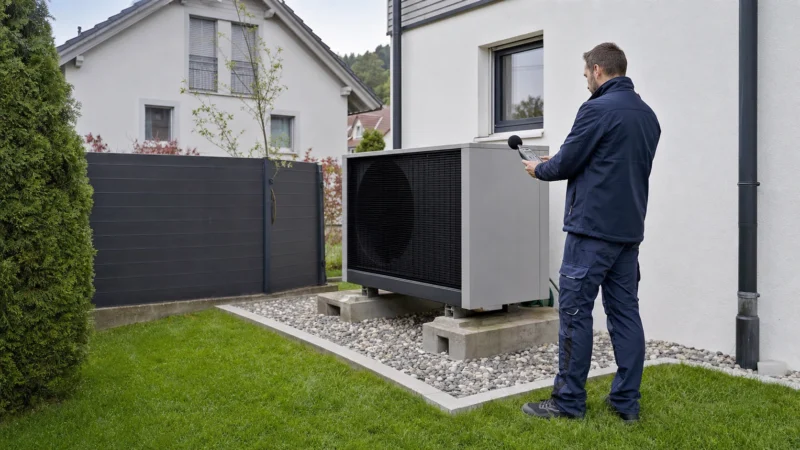
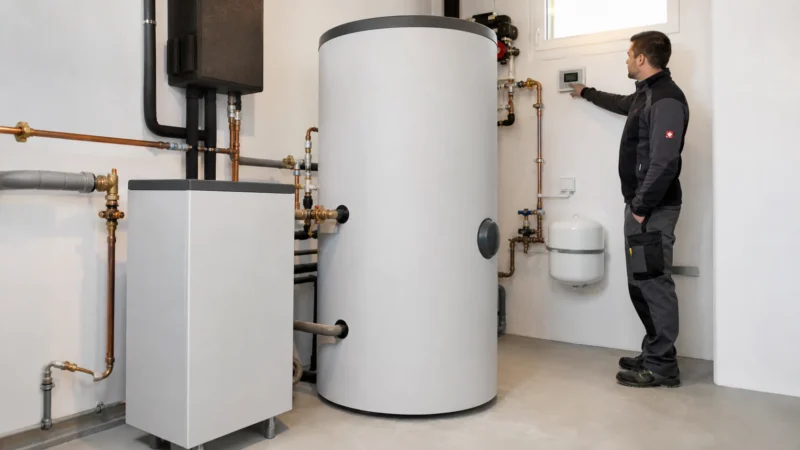
The correct sizing determines whether a heat pump operates efficiently, reliably, and comfortably. Bigger is not automatically better: an oversized system may cycle more frequently and run less efficiently. An undersized system can cause comfort problems on cold days or require auxiliary heating more often. The benchmark is therefore not the output of the old boiler, but the actual heat demand of the building.
The most important points in brief
- The heating output must match actual heat demand, rather than using the old boiler output without verification.
- The heating load indicates the output required on cold design days.
- Domestic hot water demand must be included in the design.
- If the grid operator specifies scheduled supply interruptions or special connection conditions, these must be taken into account.
- The flow temperature affects efficiency and unit selection.
- A good quote explains the design in a comprehensible way.
- As of 12.07.2026
- Sources at the end of the article
Heating load instead of gut feeling
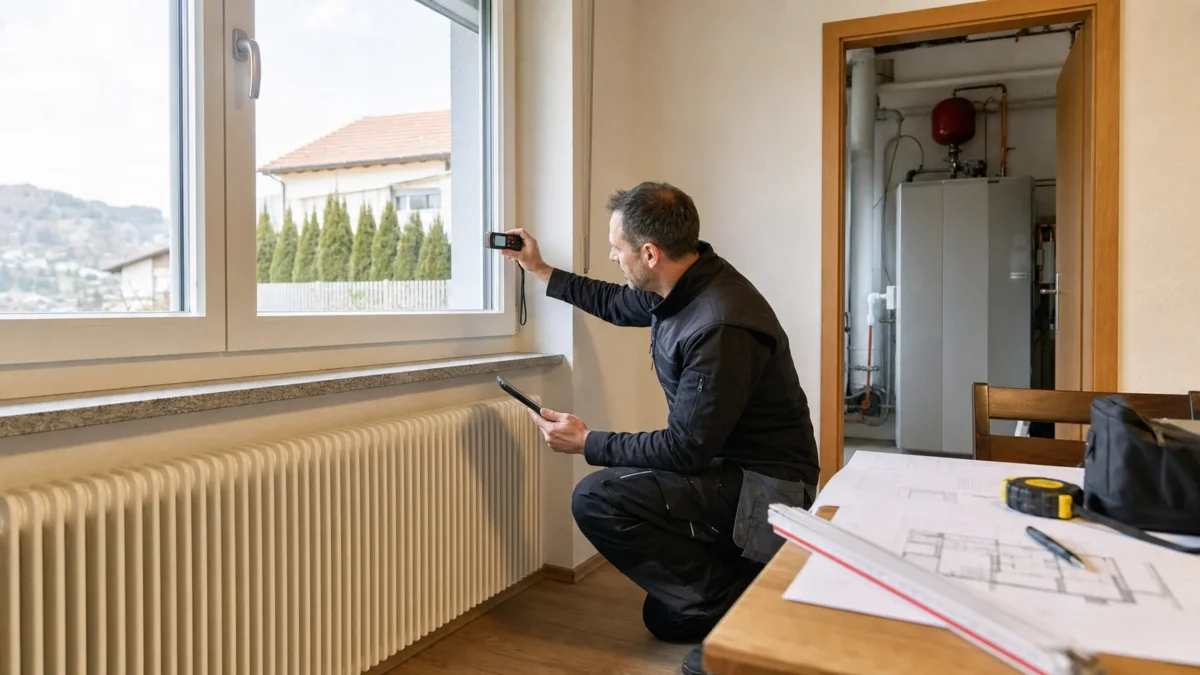
The heating load describes the output a building requires at very low outdoor temperatures to maintain the desired room temperatures. It is professionally determined according to recognised planning standards, such as SIA 384/2. Factors taken into account include, among others, the building envelope, windows, ventilation, location, heated area, room temperatures and heat distribution.
The previous annual consumption of oil, gas, or electricity helps with plausibility checks. However, it does not replace a professional calculation, as old heating systems were often operated differently or designed with safety margins.
Why the old boiler output is not sufficient
The output of an existing oil or gas heating system should not be taken over without verification. Previous boilers were often sized with reserves to ensure sufficient heat even under unfavourable conditions. For a heat pump, such a transfer can lead to unnecessarily high costs or inefficient operation.
A good quote should therefore explain on what basis the heating output was chosen.
Required data
For a reliable design, the specialist installer needs information including:
- heated living area and room heights,
- year of construction and energy efficiency status,
- Insulation, windows and roof condition,
- previous energy consumption,
- type and size of the radiators or underfloor heating,
- required flow temperature,
- Domestic hot water demand,
- people in the household,
- desired location of the heat pump,
- local connection conditions of the grid operator.
The more complete these details are, the more reliable the quote becomes.
Compare quotes for free Do you want to know what output your heat pump actually needs? You can submit your request via waermepumpen-guide.ch free of charge and without obligation. Your request will be forwarded to up to three suitable specialist installers from your region, who will check the design. Compare quotes for free
Include domestic hot water
Domestic hot water is a separate demand and must be included in sizing. A small household where showers are usually short needs a different approach from a larger household with a bath and high simultaneous demand. Storage capacity matters alongside output.
More on this: Domestic hot water with a heat pump.
Scheduled supply interruptions and connection conditions
If the local grid operator specifies scheduled supply interruptions, output limits or special connection conditions, these must be considered when sizing the system. This does not automatically mean a larger heat pump is needed, but the specialist installer and grid operator should know the conditions.
These requirements vary locally and therefore belong in the project review.
The role of the flow temperature
The flow temperature determines which equipment is suitable and how efficiently it operates. SwissEnergy points out that low flow temperatures are important for efficient operation. Buildings with underfloor heating or large radiators therefore have an advantage.
High flow temperatures do not automatically mean that a heat pump is ruled out. However, they may lead to the need to adapt radiators, improve the building envelope, or review an alternative system solution. Details: Heat pump with radiators.
Undersizing and oversizing
| Sizing | Possible consequences |
|---|---|
| too small | Comfort issues on cold days, more frequent use of supplementary heating, and potentially higher electricity costs |
| too large | more frequent cycling, less efficient operation, unnecessarily high investment possible |
| suitable | stable operation, better efficiency, transparent costs |
The goal is a system that matches the heat demand and operates as efficiently as possible.
Get a comprehensible explanation of the sizing A good quote justifies the heating output. Through waermepumpen-guide.ch you can reach up to three suitable specialist installers from your region – free of charge and without obligation. Compare quotes for free
Storage and hydraulics
Sizing concerns not only the heat pump itself. Domestic hot water storage, buffer tank, pumps, valves and hydraulic integration must also fit. A poorly integrated storage unit or unfavourable hydraulics can worsen operation, even if the equipment itself was chosen correctly.
A complete quote should therefore not only mention the kW output, but describe the entire system.
Typical errors
- Using the old boiler output without verification.
- Sizing based only on living area.
- Underestimating domestic hot water demand.
- Not checking the flow temperature.
- Not assessing radiators or underfloor heating.
- Not clarifying grid connection conditions.
- Treating storage and hydraulics only as secondary matters.
- Not asking for an explanation of the calculation in the quote.
Checklist for sizing
- Heating load professionally determined?
- Domestic hot water demand taken into account?
- Is the flow temperature known?
- Have the radiators or underfloor heating been checked?
- Justified storage size?
- Grid operator conditions clarified?
- Has the old boiler output been checked rather than simply reused?
- Does the quote clearly explain the chosen output?
The required output depends heavily on the project: a heat pump in an older building requires different input data from a heat pump in a new build. The overview of the most common planning errors also explains why old boiler output, domestic hot water and scheduled supply interruptions should not be taken over without checking.
When is it worth comparing multiple quotes?
Sizing is one of the points where quotes differ most significantly. It affects efficiency, comfort, and costs over many years. Two to three complete quotes help you determine whether the proposed output is well justified. What you should look out for is shown in the checklist for comparing quotes.
Conclusion
The sizing of a heat pump should be left to a specialist installer. Key factors are heating load, flow temperature, domestic hot water demand, heat distribution, storage, and local connection conditions. A good quote explains why a specific output was chosen. Those who compare multiple offers can better determine whether the design is plausible.
Compare heat pump quotes Through waermepumpen-guide.ch, you can submit your request free of charge and without obligation. Your request is forwarded to up to three suitable specialist installers from your region, who will check the design. Compare quotes for free
Frequently asked questions and answers
Can a heat pump be sized based on living area?
Only very roughly for orientation. A reliable design requires a professional heating load calculation and building data.
Why is oversizing bad?
An oversized heat pump may cycle more frequently, run less efficiently and cause unnecessarily high investment costs.
What is the heating load?
The heating load is the output required by a building at very low outdoor temperatures to maintain the desired room temperatures.
Must domestic hot water be included?
Yes. Domestic hot water demand affects the performance, storage size, and operation of the system.
How do scheduled supply interruptions affect output?
If the grid operator specifies scheduled supply interruptions or connection conditions, these must be considered when sizing the system.
Sources and further information
- SwissEnergy / Swiss Federal Office of Energy (SFOE): Sizing, efficiency and operation of heat pumps
- SIA 384/2: Heating load of buildings
- Swiss Heat Pump Association (FWS): Sizing, planning, and quality
- Grid operator / energy supplier: connection conditions and any scheduled supply interruptions