A heat pump does not necessarily require underfloor heating. It can also work with existing radiators – provided they emit enough heat at a moderate flow temperature. Whether this works depends less on the age of the radiators than on their size, the heat demand of the house and the required flow temperature. A blanket rejection is therefore just as wrong as a blind approval.
The most important points in brief
- Existing radiators are not a reason to rule out a heat pump.
- The required flow temperature is decisive, not the year of manufacture of the radiators.
- Large heating surfaces are advantageous because they can operate at lower temperatures.
- Often it is sufficient to replace individual critical radiators – not all of them.
- Hydraulic balancing improves distribution and efficiency.
- Underfloor heating is ideal, but not essential.
- As of 12.07.2026
- Sources at the end of the article
Why radiators are important
Heat pumps work most efficiently with low flow temperatures – that is, with heating water that does not need to be very hot. Old radiators were often designed for higher temperatures (around 60–70 °C). However, this does not rule out a heat pump: If the house requires less heat thanks to partial renovation or if the radiators are generously sized, a significantly lower temperature is often sufficient. The larger the heating surface, the lower the flow temperature can be.
Flow temperature as a benchmark
The following values are a practical orientation and not official limit values. Heating load, size of heating surfaces and room comfort on cold days are decisive.
| Flow temperature | assessment |
|---|---|
| up to approx. 35 °C | very well suited |
| 35–50 °C | often possible |
| 50–55 °C | check in more detail |
| permanently higher | Review measures (larger radiators, insulation, hydraulic balancing) |
The most indicative factor is the performance on the coldest days: If it gets warm then with a moderate flow temperature, that is a good sign. A specialist installer can derive the necessary flow temperature from the heating load, heat distribution surfaces and building condition.
Compare quotes for free Would you like to know if your radiators are suitable for a heat pump? Through waermepumpen-guide.ch, you can submit your request free of charge and without obligation. Your request is forwarded to up to three suitable specialist installers from your region who will check the suitability and create individual quotes. Compare quotes for free
Which radiators are suitable?
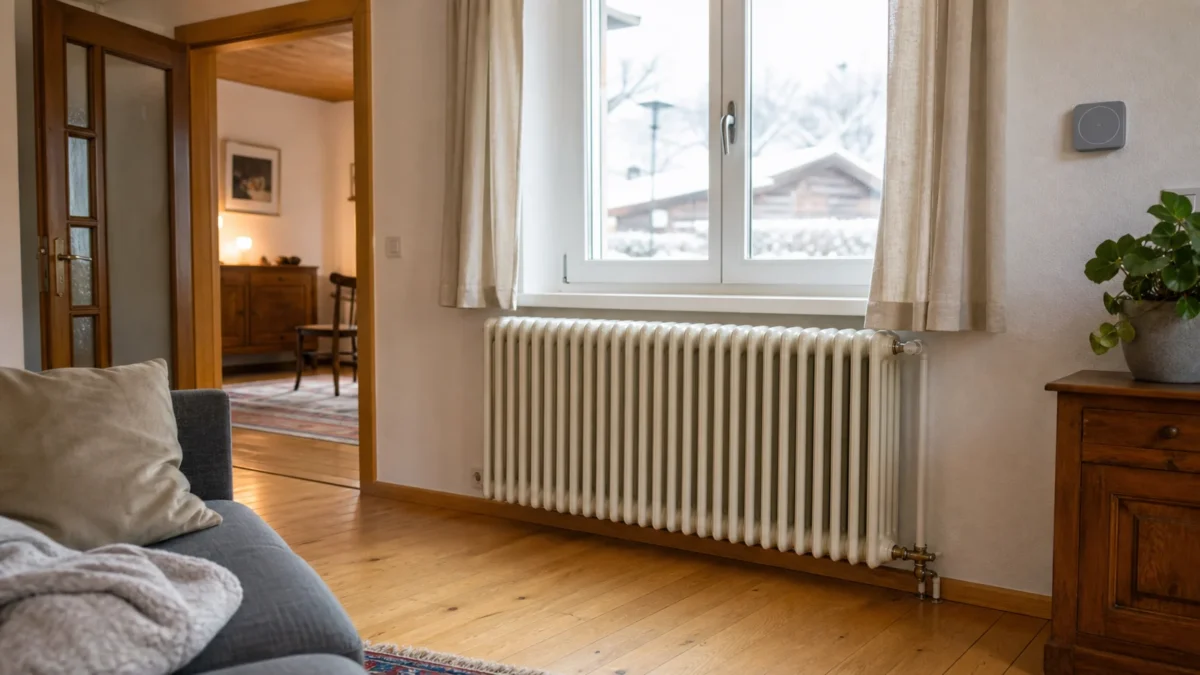
Large, extensive radiators are advantageous because they emit a lot of heat even at low temperatures. Where individual rooms do not get warm enough, the following are considered as replacements:
- Low-temperature radiators: larger design with more heating surface.
- Fan convectors: A quiet fan increases heat output and enables low flow temperatures even where space is limited.
Often it is sufficient to replace only the critical radiators, rather than replacing all of them.
When to replace radiators?
Replacement is sensible if individual rooms consistently fail to warm up or if the entire system only functions with a high flow temperature. Before replacing all radiators across the board, a targeted inspection is worthwhile: often, it is only one or two rooms that require a larger heating surface. This is usually more economical than a complete replacement.
Targeted replacement rather than replacing everything Specialist installers can assess which radiators really need replacing as part of the quote. Through waermepumpen-guide.ch, you can reach up to three suitable specialist installers in your region – free of charge and without obligation. Compare quotes for free
Hydraulic balancing
Hydraulic balancing distributes the heating water so that each radiator receives exactly the calculated amount. Without it, warm water preferentially flows to the nearest rooms, while more distant ones cool down – you then increase the flow temperature and waste efficiency. Especially when switching to a heat pump, balancing is therefore an important, often underestimated step.
Costs
As of July 2026. Specific additional costs for adapting radiators depend heavily on the building, number of affected rooms, pipe routing, radiator size, and installation effort. Therefore, they should not be assumed as a flat rate but listed separately in the quote.
| Measure | Why is it relevant? |
|---|---|
| Replacement of individual radiators | may be necessary if individual rooms do not warm up with a low flow temperature |
| Hydraulic balancing | improves heat distribution and can avoid unnecessarily high flow temperatures |
| Insulation / windows | can reduce the heat demand and the required flow temperature |
| Checking the heating curve | shows whether the house can be heated with lower temperatures |
You will find the total costs of a heat pump under What does a heat pump cost in Switzerland?; how the flow temperature affects consumption is shown in Electricity consumption of a heat pump. The broader context is provided by Heat pump in an older building.
Underfloor heating or radiators?
Underfloor heating is ideal because it operates at very low temperatures and distributes heat evenly. However, it is not mandatory – and retrofitting it is often laborious. In many existing buildings, well-sized radiators or the targeted replacement of individual radiators are the more pragmatic solution.
Typical errors
- Replacing all radiators as a precaution. Often, targeted replacement of a few radiators is sufficient.
- Not checking the flow temperature. It determines comfort and efficiency.
- Not considering hydraulic balancing. It can help distribute heat more evenly and avoid unnecessarily high flow temperatures.
- Looking only at the year of manufacture. The size and condition of the radiators matter more.
- Accepting or rejecting suitability without a specialist assessment. Both are misleading.
Checklist before making a decision
- Monitor the heating’s behaviour on cold days
- Record the size and condition of the radiators
- have the required flow temperature assessed professionally
- Identify critical rooms
- Plan for hydraulic balancing
- Take insulation and windows into account
In existing buildings, this combination is often implemented with an air-to-water heat pump. In addition to sufficiently large heating surfaces, a robust sizing of the heat pump is required; the overview of the most common planning errors shows why the old boiler output is not a suitable benchmark for this.
When is it worth comparing multiple quotes?
Whether and which radiators are replaced is estimated differently by specialist installers – this affects costs and comfort. A comparison of several quotes shows who plans specifically rather than in a blanket manner. Two to three complete quotes are generally sensible for this purpose. What you should look out for is shown in the checklist for comparing quotes.
Conclusion
A heat pump with radiators often works well – what matters is the flow temperature, not the age of the radiators. Those who use large heating surfaces, selectively replace individual critical radiators, and carry out hydraulic balancing create good conditions. Multiple quotes help to realistically assess the necessary effort.
Compare heat pump quotes Through waermepumpen-guide.ch, you can submit your request free of charge and without obligation. Your request will be forwarded to up to three suitable specialist installers from your region, who will prepare individual quotes. Compare quotes for free
Frequently asked questions and answers
Can a heat pump be used with radiators?
Yes, if the radiators provide sufficient heat at a moderate flow temperature. Large heating surfaces are an advantage.
Do I need to replace all radiators?
Not always. Often, targeted adjustments to individual, undersized radiators are sufficient.
Is underfloor heating better?
It is ideal because it operates with low temperatures – but it is not strictly required.
What does it cost to replace a radiator?
This depends on size, design, installation effort and pipe routing. The costs should be listed separately in the quote.
How do you check suitability?
Based on the required flow temperature, the heating load and the room comfort in the existing building – preferably by a specialist installer.
Sources and further information
- SwissEnergy / Swiss Federal Office of Energy (SFOE): Fundamentals and efficiency of heat pumps
- Swiss Heat Pump Association (FWS): Flow temperature, heating surfaces, and operation
- The Buildings Programme: cantonal subsidy logic for heating replacement (as of 2026)
- Energiefranken: Subsidy programmes by location